
Choosing the wrong container size is one of the most avoidable mistakes in a container purchase. Go too small and you run out of space within months. Go too large and you are paying for cubic meters you never use — and potentially dealing with a delivery vehicle that cannot access your site.
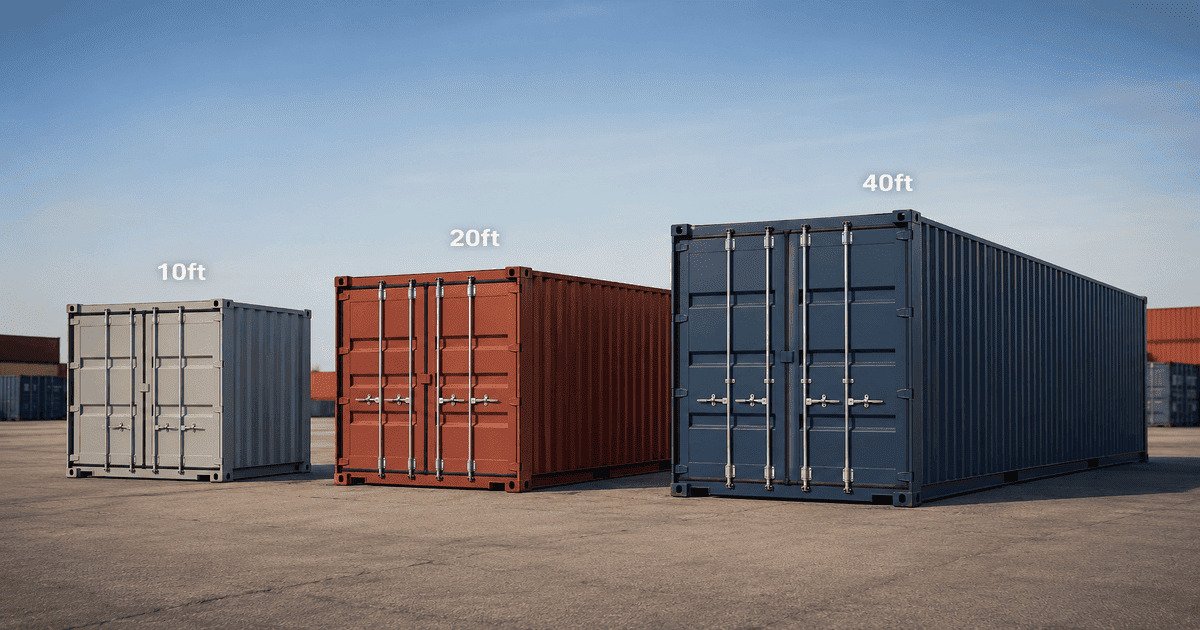
This guide covers the three standard container sizes stocked by JK Shipping LLC — 10ft, 20ft, and 40ft — with full dimensions, internal volumes, practical use cases, and site access requirements for each.
Size Comparison at a Glance
| Size | External (L x W x H) | Internal (L x W x H) | Internal Volume | Tare Weight |
|---|---|---|---|---|
| 10ft Standard | 10ft x 8ft x 8ft 6in | 9ft 4in x 7ft 8in x 7ft 10in | 15.9 m³ | 1,350 kg |
| 20ft Standard | 20ft x 8ft x 8ft 6in | 19ft 4in x 7ft 8in x 7ft 10in | 33.2 m³ | 2,300 kg |
| 20ft High Cube | 20ft x 8ft x 9ft 6in | 19ft 4in x 7ft 8in x 8ft 10in | 37.3 m³ / 1,317 cu ft | 2,420 kg |
| 40ft Standard | 40ft x 8ft x 8ft 6in | 39ft 5in x 7ft 8in x 7ft 10in | 67.7 m³ | 3,750 kg |
| 40ft High Cube | 40ft x 8ft x 9ft 6in | 39ft 5in x 7ft 8in x 8ft 10in | 76.4 m³ / 2,698 cu ft | 3,970 kg |
10ft Containers
The 10ft container is the most compact standard size in our range. At just over 9 feet of internal length and roughly 15.9 cubic meters of internal volume, it is a manageable, flexible unit that fits where larger containers cannot.
Best uses for a 10ft container:
- Tool and equipment storage on small construction sites
- Backyard storage where a 20ft unit would be out of proportion or require planning permission
- Secure storage in tight yards, alleyways, or restricted-access locations
- Base units for small conversion projects — pop-up retail kiosks, ticket booths, compact offices
- Farm and small acreage storage where access roads are narrow
Site access for 10ft delivery:
The delivery vehicle for a 10ft container is considerably shorter and more manoeuvrable than one transporting a 40ft unit. A minimum of 14 feet of clear access width is still required, but tighter turning circles and shorter approach runs are manageable. The 10ft is our most accessible container size for confined sites.
20ft Containers
The 20ft container is the global industry standard — the most common size in active use worldwide. At 33.2 cubic meters (1,172 cu ft) of internal volume in standard height (37.3 m³ / 1,317 cu ft in High Cube), it offers the most versatile balance of capacity, cost, and site access requirements.
Best uses for a 20ft container:
- General business and commercial storage — stock, equipment, documents, materials
- Residential storage — furniture, seasonal items, vehicles
- Job site offices and crew restroom units when converted
- Retail and hospitality conversions — pop-up shops, food outlets, market stalls
- Agricultural storage — feed, machinery parts, tools
- Continued international shipping use (Cargo-Worthy units)
Site access for 20ft delivery:
A 20ft container is delivered on a standard flatbed or rollback truck of approximately 35 to 40 feet overall length. Most residential driveways and commercial sites can accommodate this with proper preparation. You need 14 feet of clear access width and sufficient straight-line reversing space to the placement point. The 20ft is our most commonly delivered size and suits the widest range of site types.
40ft Containers
The 40ft container offers maximum storage capacity — approximately double the internal volume of a 20ft unit. At 67.7 cubic meters (2,391 cu ft) standard or 76.4 m³ / 2,698 cu ft High Cube, these are the right choice when volume is the primary requirement and your site can accommodate the delivery.
Best uses for a 40ft container:
- Large-scale commercial and industrial storage
- Warehousing overflow and seasonal stock storage
- Large job site offices, meeting rooms, and multi-room crew restroom units when converted
- Workshop and fabrication space conversions
- Accommodation units for remote or construction sites
- Container pool projects (contact us before ordering)
Site access for 40ft delivery:
A 40ft container requires a significantly longer delivery vehicle — typically 55 to 65 feet overall. This means a longer straight approach is needed for reversing, and tight access routes, sharp bends, and confined yards that would be fine for a 20ft delivery may not be workable for a 40ft. If your site has any access complexity, contact us before ordering a 40ft unit so we can confirm feasibility.
How to Choose the Right Size
Run through these questions before deciding:
- What are you storing, and how much of it? Estimate your cubic footage realistically — most people underestimate by 30 to 50 percent. A 20ft container fills faster than you expect once shelving, pallets, and irregular items are inside.
- What is your site access like? If your access is tight, this may determine your maximum size regardless of storage requirements.
- Are you converting the container? If so, account for the space lost to insulation, lining, flooring, and fittings — typically 10 to 15 percent of internal volume.
- Do you need headroom? If people will be working, living, or moving around inside, consider High Cube for both 20ft and 40ft sizes.
- What is your budget? Two 20ft containers may cost more than one 40ft — or less, depending on current market availability. Contact us to compare current pricing.
Not Sure? Contact Us First
If you are undecided between sizes, or want to confirm that a specific size can be delivered to your location, contact our team before placing an order. A brief conversation about your site and intended use will give you a clear answer.
JK Shipping LLC
📞 +1 (251) 247-6208
📧 info@jkshippingllc.com
🕐 Monday to Friday, 8:00 AM – 5:00 PM (CT)
Where to go from here
The stock and reference pages this guide relates to.
- 20ft containersShop the range
- 30ft non-standard containersShop the range
- 40ft unitsShop the range
- Compact 10ft unitsShop the range
- Ask us about your projectCherokee, Alabama