
Getting a shipping container delivered sounds straightforward — and when everything goes to plan, it is. The container arrives, the driver places it, you sign the receipt, and you are done.
When things go wrong, it is almost always because of one reason: the site was not ready. A delivery vehicle that cannot access your property, ground that cannot support the container, or overhead obstructions that block the approach — any one of these turns a smooth delivery into a redelivery fee, a rescheduled booking, and a frustrating experience for everyone involved.
This guide covers exactly what you need to check and prepare before your JK Shipping LLC delivery is scheduled. Read it before you place your order — not after.
How Container Delivery Actually Works
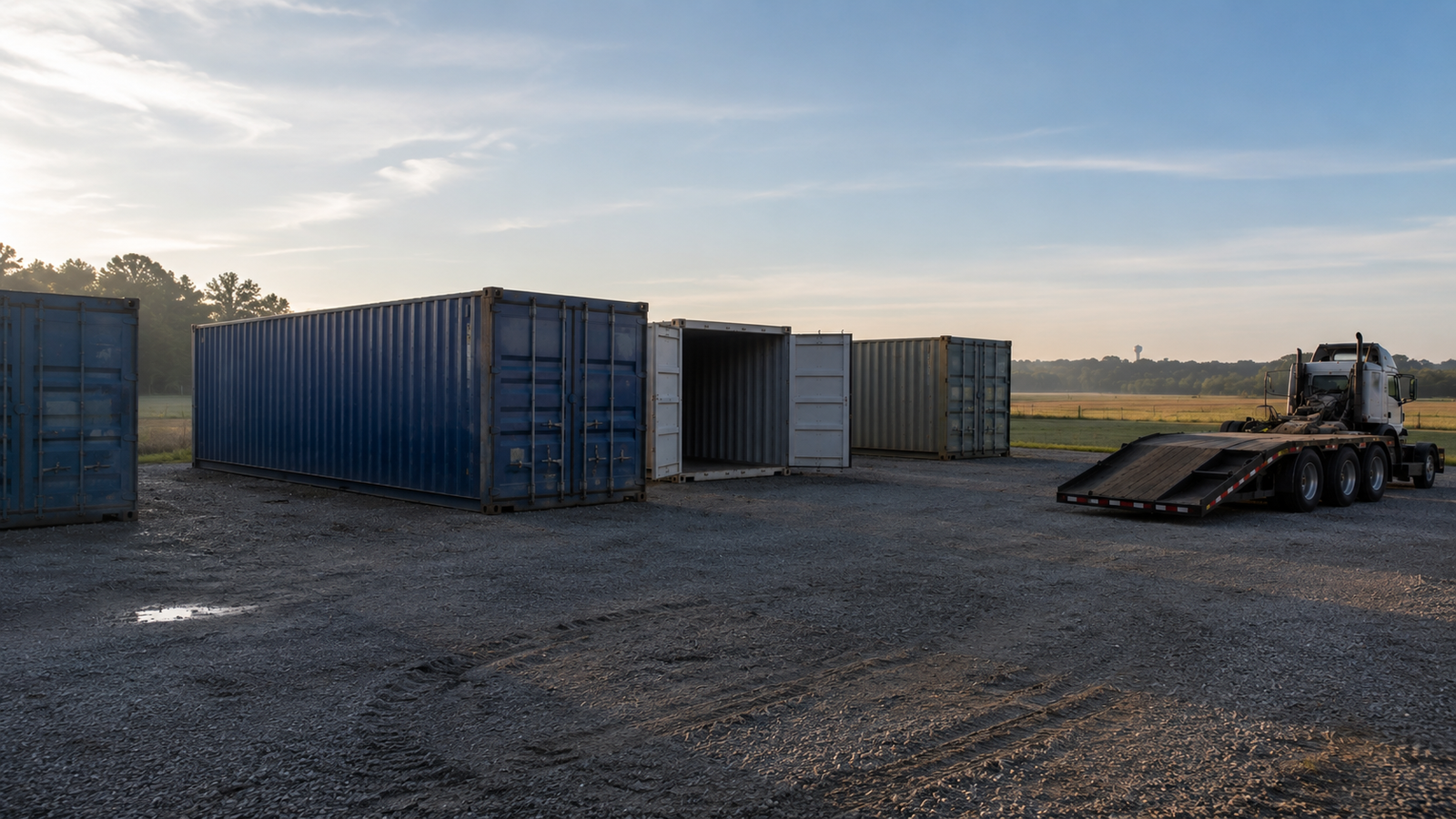
Before getting into site requirements, it helps to understand the delivery process. Shipping containers are not delivered by a courier or parcel carrier. They are transported by flatbed truck, rollback trailer, or tilt-bed vehicle — specialist freight vehicles that operate very differently from a standard delivery van.
A tilt-bed or rollback truck works by tilting its bed at an angle and sliding the container off onto your chosen placement point. This means:
- The truck needs to reverse in a straight line toward the placement point
- The container slides off the back — it does not get lifted by crane or forklift in a standard delivery
- The truck needs clear, level space behind it to complete the tilt without obstruction
- The ground at the placement point takes the full weight of the container as it slides off
Understanding this process explains why site preparation matters. The driver cannot place a container on soft ground, cannot manoeuvre a 60ft vehicle around a tight bend, and cannot slide a container under power cables. These are physical constraints, not policy preferences.
Access Requirements
Access Width
The delivery vehicle needs a minimum of 14 feet of clear width along the entire approach route to the placement point — not just at the entrance. This includes:
- Gate openings and entrance points
- Any narrow sections along the driveway or access road
- Space between parked vehicles, walls, trees, and fences along the route
If any section of the approach route is narrower than 14 feet, the driver will not be able to safely complete the delivery. Measure the narrowest point of your access route — not the widest — and confirm it meets the minimum before booking.
Overhead Clearance
Check the full approach route for overhead obstructions. The delivery vehicle and container combined can reach 14 feet in height or more during the delivery. Obstructions to look for include:
- Power lines and telephone cables
- Tree branches overhanging the driveway
- Garage door frames, canopies, or entrance structures
- Low bridges or height-restricted access roads
If you have overhead cables crossing your access route, contact the relevant utility company before your delivery is scheduled. Do not assume the driver will be able to pass beneath them safely without measuring.
Turning Space and Approach Angle
The delivery vehicle needs sufficient room to line up and reverse toward the placement point in a reasonably straight line. Sharp bends, tight corners, and confined yards make this significantly more difficult and may prevent delivery altogether.
- 10ft and 20ft containers: More manoeuvrable — can be delivered to tighter sites than 40ft units
- 40ft containers: Require a longer straight reverse approach. If your access involves more than one turn, contact us before ordering to confirm feasibility
Ground Preparation
This is the area where most delivery problems occur. The ground at your placement point needs to be:
Level
Containers are designed to sit on four corner castings. If the ground is significantly uneven, the container will not sit flat — the doors may not close properly, the floor will be stressed, and the structure can warp over time. The placement point should be as level as possible. Minor slopes can sometimes be compensated for with bearers, but steep or uneven ground is a problem that needs to be addressed before delivery.
Firm and Load-Bearing
A standard 20ft container weighs approximately 2,300 kg empty. A 40ft container weighs approximately 3,750 kg empty. Add the delivery vehicle’s weight to that as it manoeuvres and you have significant ground loading during placement.
Soft, waterlogged, or freshly disturbed ground will not support this safely. The following surfaces are suitable for container placement:
- Concrete pad — the most stable and level option. Ideal for permanent placements
- Compacted gravel or hardcore — suitable for most containers if well-compacted and level
- Railway sleepers or solid timber bearers — positioned under the four corner castings, these spread the load on softer ground
- Paving slabs on firm sub-base — suitable for lighter containers on stable ground
Surfaces to avoid without proper preparation:
- Soft or waterlogged soil — the container will sink unevenly over time
- Freshly laid turf or topsoil
- Loose gravel without a compacted sub-base
- Sloped or unstable banking
Tip: If you are placing a container on grass or soil, lay four concrete blocks or solid timber sleepers under where the corner castings will land before delivery day. This is inexpensive, quick to do, and prevents the most common post-delivery complaint — a container that has settled unevenly after the first wet winter.
What Happens on Delivery Day
Once your delivery is confirmed and scheduled, here is what to expect:
- You will receive your carrier’s contact details and an estimated delivery window — typically a half-day or full-day window
- The driver will call ahead on the day to confirm arrival time and final access details
- You or a representative must be on site to guide the driver to the placement point and sign the delivery receipt
- The driver will position the vehicle and slide or tilt the container off the bed onto your prepared placement point
- Walk around the container before signing the delivery receipt. Check doors, seals, and visible condition. If you notice anything that differs from what was described, note it on the receipt before signing and contact us within 48 hours with photos
Common Mistakes That Cause Redelivery Fees
These are the most frequent issues our logistics team encounters. Each one can result in a failed delivery and a redelivery charge.
- Not measuring the access route — assuming a gate or driveway is wide enough without physically measuring it
- Overhead cables not identified in advance — cables across the approach route that were not flagged when the delivery was booked
- Soft or unprepared ground at the placement point — the driver arrives and the ground cannot safely support the delivery
- Nobody on site at delivery time — the driver cannot leave a container unattended without a signed receipt
- Placement point changed on the day — asking the driver to place the container somewhere different from what was agreed can require a complete reposition of the vehicle and may not be possible depending on site layout
- Not communicating about parked vehicles or temporary obstructions — a car parked on the access route on delivery day can block the approach entirely
Checklist — Before You Book Your Delivery
Use this checklist before contacting us to schedule your delivery:
- ☐ Access route measures at least 14 feet wide at the narrowest point
- ☐ No overhead obstructions below 14 feet along the full approach route
- ☐ Sufficient straight-line reversing space for the delivery vehicle at the placement point
- ☐ Placement point is level or near-level
- ☐ Ground at placement point is firm and load-bearing
- ☐ Concrete blocks, sleepers, or bearers in position if placing on soil or grass
- ☐ Someone will be on site for the full delivery window
- ☐ Access route will be clear of parked vehicles on delivery day
Not Sure if Your Site Qualifies?
If you have any doubt about whether your site meets the delivery requirements — particularly around access width, turning space, or ground conditions — contact us before placing your order. We would rather have a five-minute conversation that confirms everything is workable than deal with a failed delivery that costs you time and money.
Our team has experience with a wide range of delivery sites — from tight residential driveways to rural properties with unpaved tracks. In most cases we can find a solution. In some cases the honest answer is that a standard delivery vehicle will not be able to reach your placement point and we need to discuss alternatives. Either way, that conversation is better had before your order is placed.
Ready to Order?
Browse our full container range and place your order online. Once your order is placed a member of our team will contact you within 1 business day to begin arranging delivery and confirm your site access details.
- Browse 20ft Containers
- Browse 40ft Containers
- Browse 10ft Containers
- Read our full Shipping and Delivery Policy
JK Shipping LLC
📞 Phone: +1 (251) 247-6208
📧 Email: info@jkshippingllc.com
🕐 Hours: Monday to Friday, 9:00 AM – 5:00 PM (CST)